
Taylor Resident Lookup Records
A useful Taylor resident lookup separates the question from the record. A Taylor tax or assessment record can identify the taxpayer, recorded owner, mailing address, situs address, parcel, and tax year, but it does not prove occupancy. A court index can place a named party in a case, while a vital-record route answers a death, marriage, birth, or family-history question under its own access rules. Michigan voter records and public professional or entity records may provide limited corroboration when their fields fit the purpose. Each source has a different custodian, date, and meaning.
| Record | What it can confirm | Taylor-area custodian | Access route |
|---|---|---|---|
| Assessment or tax record | Parcel labels, taxpayer or owner fields, and tax context | Taylor Assessor and Wayne County Tax View | Portal, phone, email, or city Contact form |
| Public court case | Named participant, court, case number, dates, and public status | 23rd District Court and Michigan MiCOURT | Online index, then court or clerk for an official copy |
| Vital record or index | Event research within the applicable certificate rules | MDHHS, Wayne County Clerk, or Taylor City Clerk | State, county, or local application route |
| Voter record | Permitted registration and status information | Michigan Bureau of Elections and Taylor City Clerk | MVIC or a QVF public-record request |
| License or entity record | Public credential or organization context | Michigan LARA | Online verification or certificate request |
Use the address route when the question concerns a parcel. Use a court route for a known case concern. Use the vital custodian for an event record, and use the election route only for permitted public registration information. The Taylor assessor says requests may be made by phone, email, or the city Contact form, with a stated response target of seven business days. That fallback matters when the linked BS&A portal does not expose what is needed.
Note: A record source can corroborate a fact without proving current residence, identity, or a relationship between people with the same name.
Taylor Resident Lookup Through MiCOURT
Taylor's court quick-links page identifies the 23rd District Court and directs public case searches to Michigan MiCOURT. The court is at 23365 Goddard Road in Taylor and handles misdemeanors, civil cases, small claims, municipal infractions, traffic matters, and civil weddings. MiCOURT is a name and case index, not a final identity decision. A record may belong to another person with the same name, and a Taylor resident may instead have a Wayne Circuit or federal case.
The official MiCOURT case search supports free-text case-number or participant-name fragments. Documented qualifiers include first name, last name, full name, and case number, with filters for category, year, status, public status, filing date, and disposition date where available. The portal warns that results are informational, not certified, and that excluded, sealed, older, juvenile, protection-order, adoption, mental-health, and other records may not appear.
The official Taylor court links are shown in this source image.
Use the city link to confirm the Taylor court route before treating a portal search as the court's complete file.
The public MiCOURT start page is documented in this source image.
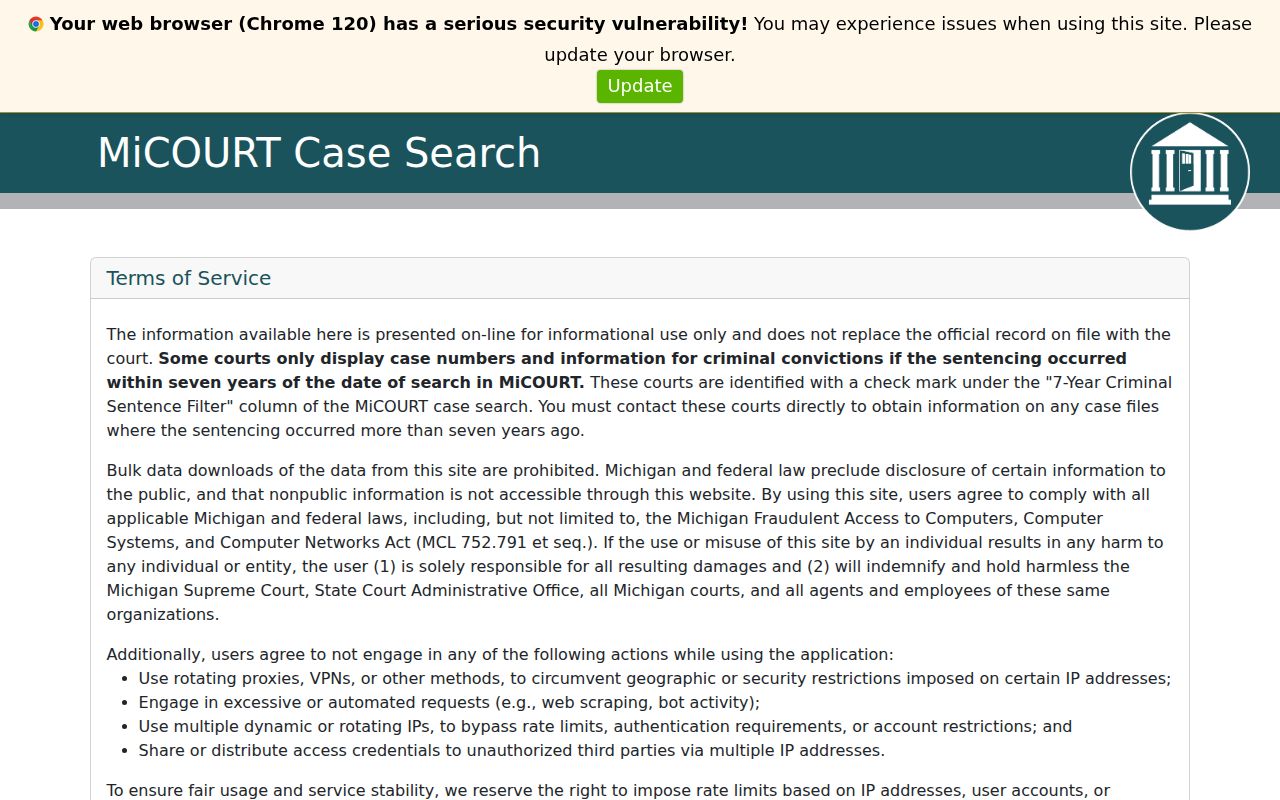
Request a docket, disposition, pleading, or certified copy from the actual court when that document is required.
Taylor MiCOURT Result Window
MiCOURT's documented result pagination begins at 20 and can reach a maximum of 500. That is a search-display limit, not a count of a person's records. A broad name should be narrowed by court, year, participant role, case type, or known case number before reading a result. The result schema may include a case number or tracking ID, court name and contact information, participant name and role, case type or status, filing and disposition dates, and public charge or disposition details when available.
Keep a retrieval date with the result. A later docket update, a public-status change, or a different case category may change what a later search returns. Older Taylor cases not found online should be routed to the court, while Wayne Circuit civil, domestic, and historical court materials use the Wayne County records service. Federal court material uses PACER separately and should never be merged into a state-court match just because the name matches.
Taylor Vital Records for a Resident Lookup
For an event record, begin with the custodian rather than a general name search. Michigan Department of Health and Human Services maintains Michigan vital records from 1867, with divorce records listed from 1897. It offers mail, its authorized online and phone service, a drop box, and appointment channels. The state lists regular, expedited, genealogy, and authenticated processing tracks. Birth records under 100 years are restricted to listed eligible people and representatives, while death, marriage, and divorce routes have broader public access subject to the form, identification, fee, and record-type rules.
The official MDHHS vital-record ordering page provides the statewide entry point, and the page is captured below.
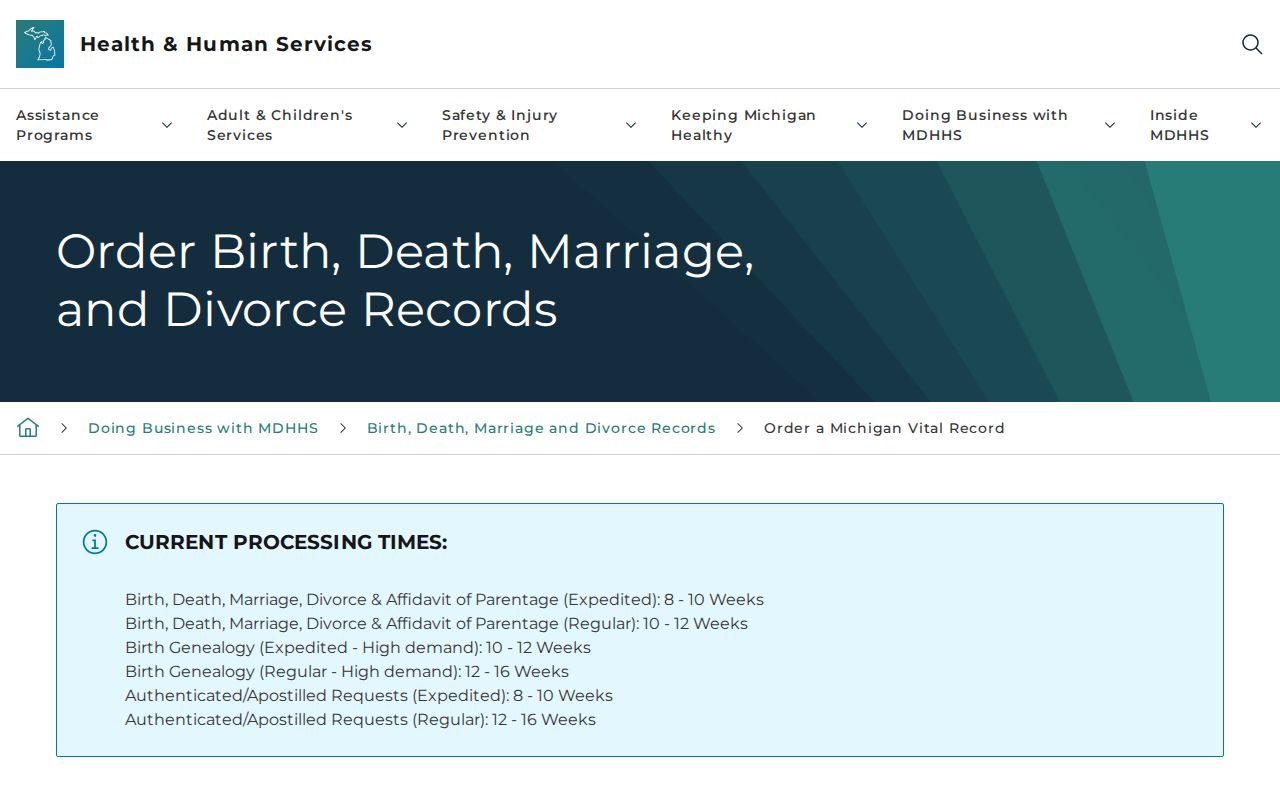
The state route should be checked against the local route before payment because Taylor, Wayne County, and MDHHS publish different instructions.
Wayne County Clerk maintains birth and death transcripts for county communities outside Detroit and marriage certificates, so a Taylor event may be held there. Taylor also publishes a certified death-record route for deaths in Taylor by mail or in person. Confirm the event location, date, relationship, and current fee with the chosen office.
Taylor Voter Records in a Resident Lookup
Michigan's Qualified Voter File is maintained by local and county clerks with the Bureau of Elections. The Secretary of State says public voter-registration records are available under FOIA, but the public record does not include driver-license or state-ID numbers, month and day of birth, phone, email, digitized signature, last four Social Security digits, and other protected registration fields. Registration data can corroborate a permitted status at a date. It is not proof of a person's continuous residence or a license to assemble a household profile.
Michigan Voter Information Center is the individual voter and election-information entry point, although its exact public fields were not captured during research because the site returned HTTP 403. The official page appears in this source image.
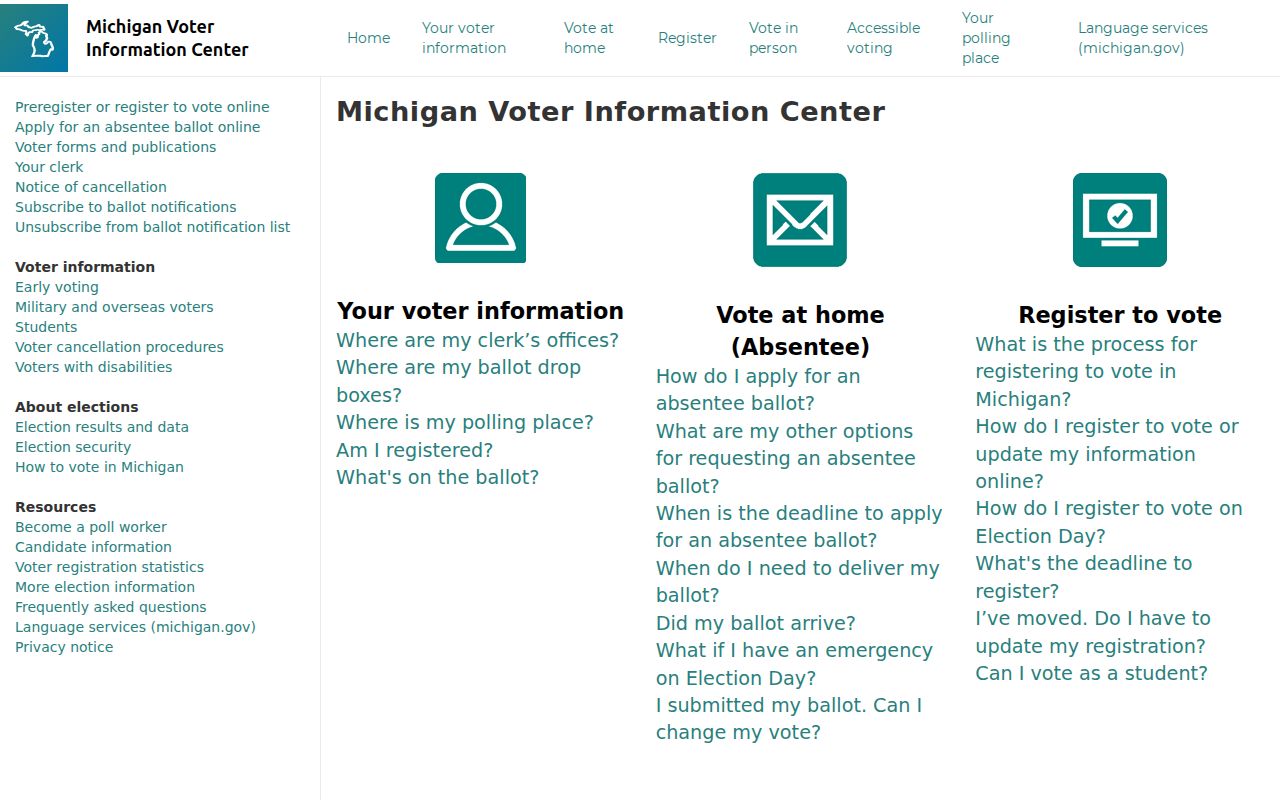
Use the live portal's current instructions rather than assuming it accepts every kind of name or address query.
For a defined public-record request, the QVF Data Request Form supports scopes such as state, county, jurisdiction, district, school, village, ward, and precinct. Taylor City Clerk handles local election administration; locally maintained records may also be requested from that clerk.
Verifying a Taylor Resident Match
Verification means testing whether two records refer to the same person, not collecting every available reference. Begin with a lawful, low-detail source and add only facts that address the exact question. Match on two independent facts such as municipality and year, address and date, or court and case number. Do not rely on a phone number, full birth date, protected address, or personal identifier to force a match.
- Write down the name form, known Taylor or Wayne County connection, and the date range that matters.
- Use the relevant city or county record to anchor the person to a dated address, parcel, court, or event.
- Search MiCOURT with a name variation, then compare court, year, role, and case number instead of names alone.
- Request an official copy from the custodian only when the question requires one.
- Docket
- A docket is the court's running list of filings and events in a case.
- Index and image
- An index lists fields to locate a record. An image is a scan of the underlying document and may have separate access rules.
- Certified copy
- A certified copy is issued by the custodian with official certification. A portal screen is not a substitute.
Older historical leads are handled differently. The Taylor City Directory route points to library and regional collections, but research did not verify a Taylor-specific city-directory year run. Treat a historical entry as a lead, then confirm its locality and original image before connecting it to a modern record.
Note: A namesake comparison should stop when the remaining distinction would require protected data or speculation about a private person's identity.
Taylor Resident Lookup Adoption Route
A birth-parent question has a dedicated Michigan route, not an open resident search. The state adoption-records information identifies the Central Adoption Registry and the Confidential Intermediary Program. Registry statements can record consent or denial of information release, but an individual adoptee does not contact the registry directly. A court or agency performs that check under the published process.
The Confidential Intermediary Program is court-administered under MCL 710.68b through the court where the final adoption order was entered. Eligible petitioners can include adult adoptees and certain family members, subject to date and eligibility rules. The intermediary conducts a confidential search and may ask the located person about written consent or communication. This respects the person's choice and does not turn identifying information into a standard resident lookup result.
Taylor Resident Lookup Safety Limits
Michigan FOIA, MCL 15.231 et seq., provides a way to request existing nonexempt public records. It does not require an agency to create a resident list, answer a research question, or disclose protected data. A written request should identify the record, date range, department, and format with enough detail for the agency to locate it. A public body generally responds within five business days, with a permitted ten-business-day extension. Fees may cover search, review, separation, copying, and mailing under the statute's rules.
Michigan's Address Confidentiality Program offers eligible people at risk from domestic violence, sexual assault, stalking, or human trafficking a designated address and mail-forwarding service. The actual address is not a normal directory field. If a search could expose a protected person's location, stop rather than trying to reconcile deeds, tax records, voter data, or maps. Corrections and privacy questions belong with the record custodian.
Lawful use. Use Taylor resident records for personal, civic, genealogy, reconnecting, or safety-navigation purposes. Never use a result to stalk, harass, intimidate, or expose a protected person.
Taylor FOIA Resident Record Fallback
When a portal has no result, use the office that keeps the record rather than guessing. Wayne County's general FOIA request form directs county requests to its FOIA Coordinator and supplies an online portal and email route. Taylor municipal materials should go to the relevant city office, and state records to the state custodian. Describe an existing record rather than asking staff to build a dossier or a new directory.
A no-result can reflect a spelling variation, a different court, an online coverage cutoff, a protected category, or an archive-only record. The 23rd District Court, Wayne County Clerk, Taylor City Clerk, MDHHS, and the Taylor assessor each hold different material. Use the precise custodian, retain its reply, and verify the live form, fee, and access instructions before submitting a request.